Tag Archives: David Foster Wallace

On William Langewiesche

I suppose hearing about your heroes dying is just a part of growing older, but I don’t like it one goddamned bit. 

This feeling is prompted by news of the recent death of William Langewiesche at 70 from prostate cancer. Langewiesche was known for his reportage in The Atlantic Monthly beginning in the 90s. As a former pilot he wrote frequently about airplane crashes, and more generally about disasters that were somehow the result of human ingenuity, technology, and hubris. I don’t know how to pronounce his name either. 

I first read Langewiesche in a graduate school creative nonfiction workshop. The book was Sahara Unveiled. The bit that got me was when Langewiesche is stranded in the Sahara, and slowly interweaves his predicament with a methodical explanation of how people die in the desert. At what point do they start drinking their own urine? Etc. The prose is in the Hemingway vein, focused on concrete and physical particulars, withheld emotion, friction and complexity created by juxtaposition. We aren’t ever directly informed of Langewiesche’s feelings, but we still have feelings reading him. He invokes them rather than performs them. 

Langewiesche became one of those writers whose essays I’d stalk in the newstands, and a summer or so later, when his long articles about the post-9/11 cleanup of the World Trade Center appeared, I would greedily consume each installment as soon as it became available. That was one of those fortuitous intersections of modern journalism and my tastes at the time. I didn’t know I wanted to read thousands of words about how to clean up the destruction from that event, but once Langewiesche’s first article came out, I couldn’t envision anyone better for the task.

I still have those Atlantic issues somewhere in my files. Those essays, which eventually became the book American Ground: Unbuilding the World Trade Center, were some of the key texts for me in those grad-school years after 9/11 — bits of nonfiction that were written almost immediately after the attacks and stuck with me. The others were “The View from Mrs. Thompson’s” by David Foster Wallace, which appeared in Rolling Stone, and a paragraph from Susan Sontag, which appeared in a round robin of regular writers in the New Yorker immediately after the attacks. Sontag notoriously wrote, “Let’s by all means grieve together. But let’s not be stupid together.” 

She was vilified for this paragraph, and this game of mutual provocation, the endless pickle ball tournament of statement and mock outrage counterstatement, was my introduction to the world of American discourse. It’s been downhill ever since for mutual understanding and my mental health. I’d read Against Interpretation the year before and felt like a gigantic redneck, but not an uninterested redneck. That is, I didn’t feel stupid, like I did whenever I tried to read, for instance, Foucault or Derrida; I just felt uncultured, like I was living way out in the sticks. The next book of hers I read was On Photography, which I adored, and from which I quoted sloppily for the rest of grad school. I did not get invited to many parties. 

I admired Wallace’s writing so much that I now regard his influence as a kind of persistent infection, latent but always ready to strike if I don’t watch my diet. I still have his issue of the Atlantic, too.

Obviously these three writers are quite different. I can only imagine their awkward dinner conversation, or the MFA thesis defense where they all sit stiffly on the same couch. They would never hang out together. They would smirk at the mention of the others’ names. And yet they each presented viable modes, worthy models. Langewiesche was exemplary of a certain tradition. He presented a way to be a masculine writer that wasn’t chauvinistic or corny or deliberately retrograde. It feels weird talking about this in hyper-enlightened 2025, but these feelings existed then. One could argue that the Hemingway mode, both the prose and the attitude it embodied, moved from American short fiction into nonfiction reportage — the male figure caught in extremis, a kind of staged adventure. The masculine tendency to get oneself into physical scrapes, often involving the wilderness or complex machinery, or if one’s lucky both, moved almost entirely into the journalism-adjacent slick magazine-financed world in the 1990s and 2000s. In the 80s you had your Raymond Carvers, your Richard Fords. Then came your Tom Bissells, your Wells Towers. Your Hampton Sides and your John Jeremiah Sullivans. All these dudes had great names. This manly short story to slick magazine reportage crossover enabled not just some financial stability, but also an escape hatch from the self-awareness constraints that plagued ambitious contemporary American fiction. That is, everyone knew fiction was artificial, a barker tent full of scams and devices and tricks. It was clearly emotionally and intellectually manipulative. But that conceptual baggage did not exist for narrative nonfiction, at least not back then. Postscript: these dudes now just write for TV. Man’s gotta eat. 

All of which is to say that Langewiesche represented a distinct path, clearly allied with a tradition while not trapped inside its castle. He discovered new places, and drug them back to us with his sentences. I will miss them. 
Mirrors, carried down roads

I’m happy to report that I have a new essay up at Open Letters Monthly. It’s called “My Disappearance” and it’s about teaching creative writing, David Foster Wallace, the idea of mentors, being turned into a fictional character, and John Barth. And so much more!

Well, not really: that’s actually what it’s about, but you know, spooled out into many more words and riveting anecdotes. Anyway, please go check it out. I can’t think of any pithy, meta angle to take on this piece; it’s already fairly meta as it is.

Okay, I lied: here are two meta-bits. In the essay, there’s some stuff about funhouse mirrors, à la Barth’s Lost in the Funhouse, and this has gotten me thinking about weird mirror effects. I’ve only taken a few selfies thus far in my life, which probably tells you more about my age and disposition than I care to admit, but one of them was in an elevator, alone, just as the doors closed. It was one of those elevators whose door interior was all reflective, and I had two competing reflections of myself sliding toward each other on each half, except that when they met and sealed me in, my head disappeared. The rest of my wide body reflected, but my noggin was erased. And that’s the photo I got. I’m not sure where that photo is at the moment, or I would post it. It’s lost somewhere in the ever-expanding junk drawer of digital documentation. Someone should become the Marie Kondo of data storage.

Second, Graceland. Everyone should visit Graceland, not just because Elvis lived there but because the combination of irony and sentiment and kitsch whirs together into something that ends up feeling like pathos. But one of the many great moments in Graceland, when you take the tour, is when you walk down the stairs into Elvis’s basement. The walls and the ceiling of the stairwell are completely covered in mirrors, and the panoramic reflection of yourself and the rest of the tourists is overwhelming. If there is a heaven, Elvis is there, giggling.

Notes on the new DFW reader

Last week I noticed via Kottke that the publisher Little, Brown has just published a David Foster Wallace Reader. This makes me happy, as I’ve thought that since his death the two Wallace books that “needed” to exist were a) a collection of his nonfiction and interviews and b) a reader, so that he would be more easily teachable in college courses. This last idea came from my own teaching days, when I occasionally longed to include a kind of DFW Swiss Army knife on a syllabus.

Now that it’s out there and I can inspect the table of contents, I, of course, have opinions. Harumph, harumph. Why have they decided to include syllabi and teaching materials from the college courses Wallace himself taught? I’m of two minds about this. On the one hand, I’ve often thought that one of the aspects that made Wallace so interesting and compelling a writer was that he was always himself, his sensibility burned through whatever genre he was working in, so that his fiction and nonfiction and even his interviews had the same grain of energy. And yes, even his syllabi. The ones that I’ve read online have the same level of wit and attention to language. It sounds weird — it sound kind of creepy, given his cultish status — but the syllabi are interesting in and of themselves as written artifacts.

As pieces of art? I dunno. That takes more interpretive energy than I’m willing to muster currently. But I’m not sure they really belong in a reader. It feels a little funny to re-contextualize them in this way, which is a kind of Whitman sampler of the Great Man’s Work. Reading his syllabi and class correspondence feels like it should be the next level of Wallace interest, for intrigued autodidacts to seek it out. Like the re-publishing of his graduation speech in book form, the class materials seem to sanctify the person, to burnish the icon. Though without the book in front of me and not having read the syllabi in question, I am merely blowing out thought bubbles here. I’m just being opinionated.

Which reminds me: is it possible to write online without falling back on opinion bubbles? The writer Paul Ford has said that the engine of all internet activity comes down to the self-righteous question “why wasn’t I consulted?” And you don’t have to do much exploring to see how online writing has degenerated into a series of “takes” on the subjects of the day. So how does one (or perhaps more accurately, why does one) write on the internet without devolving into an editorial writer hepped up on speed? Because quickly formed opinions on complex matters do not typically lead to graceful prose, or even just interesting prose, much less well-built ideas. It leads to a kind of performative morality, a kind of keyword call and response, rather than actual debate or searing sentence construction.

Reading and writing online, I’ve started to realize how tired I am of everyone’s opinions on everything. And I don’t exclude my own opinions from this. My own little thought bubbles are tired, slightly shriveled — like grocery balloons four days after the party, huddling in the corner of the dining room. They only float when kicked.

And yet here I am contributing to the very problem by having and now articulating my own personal bubble re: the arrival of this new collection of Wallace’s writing. I often wonder: if Buddhism is based in part on removing desire from oneself, then might a corresponding Buddhistic internet mode be something like removing one’s opinions from oneself. What if having an opinion were basically a manifestation of a desire? A desire to be consulted on a topic, and that internet writing was the rage made manifest of that thwarted desire? What if one could write on the internet without recourse to expressing an opinion about everything?

I’m not sure I’m strong enough.

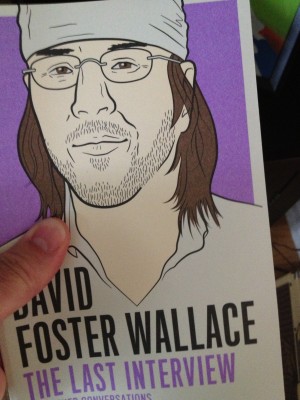
DFW: The Last Interview, Reviewed

David Foster Wallace, The Last Interview

There’s a new issue of the Quarterly Conversation out. Not only does it have my review of David Foster Wallace: The Last Interview, it also contains Andrew Altschul on Wallace’s posthumous collection of nonfiction Both Flesh and Not, David Winters on Sam Lipsyte’s new story collection, and Dev Varma on Azareen van der Vliet Oloomi’s novel Fra Keeler. I included that last one because Varma is a friend and I enjoyed getting to type all of those letters. Enjoy!

David Foster Wallace Symposium Makes Waves

Hello. I am happy to announce that the latest issue of the Quarterly Conversation has been published and it contains a gigantic symposium/where-are-we-now collection of essays on David Foster Wallace. And I’m happy to be included.

My essay is about Consider the Lobster, Wallace’s second collection of essays. I talk about how Wallace’s nonfiction is, in general, just plain great, but also how his nonfiction fits within the current ecology of literary writing that is not fiction or poetry, i.e., creative nonfiction, literary journalism, literary fiction, the Essay, New Journalism, Lyric Essay, or whatever handy or not-so-handy moniker you prefer. I also talk a bit about everyone’s favorite manifesto from last year, David Shields’s Reality Hunger.

I don’t remember if I mentioned this in the essay but it feels worth being redundant: we seriously need two types of Wallace books to be published. And by Wallace books I mean posthumous collections of his work. First, we need a book of his uncollected nonfiction. There are a couple of late, great pieces: the Federer piece, the graduation speech. (Yes, I realize they published that last one, but I’m talking about publishing it in a version for actual grown-ups, rather than the annoying, cloying, exploitive, one-sentence-per-page edition that’s out now.) But there are also lots of early book reviews that are languishing in forgotten back issues of various journals. I had a phase during graduate school when I would obsessively locate these essays either within the bound back issues or through Interlibrary Loan (ILL!), typically during the times when I should have been collecting scholarship for my academic papers. There is one out there about fiction and the “conspicuously young” that’s a wonderful explication of the difficulties of graduate creative writing programs and how they affect teachers, students, and the publishing industry in general. It actually adds nutritional meat to the whole MFA Good/Bad debate. Anyway, before I go hunting through my files to start quoting from the thing, my main point is: there’s a good-sized book there and an audience who would appreciate it and buy it.

Second, we need a Portable Wallace, a la the Portable Faulkner. I realize that Wallace’s reputation is not foundering; he needs no Malcolm Cowley to call attention to his greatness or to marshall the forces of culture to keep him in print. I say this instead as someone who has taught college. The problem is Wallace is hard to teach–not in terms of explication/analysis (though, I mean, that too), but in terms of just having a usable edition of his work. Because his greatest piece of fiction is Infinite Jest, and because the most conveniently teachable pieces of his short fiction and nonfiction are scattered between various editions, it would be awfully nice to have a 500-paged paperback with a handful of essays and a good chunk of his fiction. That way you could show what Wallace was up to in various genres without having to dedicate an entire semester to it simply because of the books that one would have to buy.

Before I get too full of myself and start rattling off all the other books I think we need published (a collection of Cynthia Ozick’s essays on Henry James? an updated edition of Peter Taylor’s Collected Stories?), let me also mention all the other great DFW-related essays in the issue: my main man Scott Esposito on Infinite Jest; Edie Meidav on A Supposedly Fun Thing; CJ Evans on Brief Interviews; Lance Olsen on Oblivion; John Lingan on The Pale King; and Andrew Altschul on “The Suffering Channel,” among other things. I’m happy to be a part of this symposium, especially since after the initial publicity wave for The Pale King crested and dissolved, Wallace-related criticism seemed to dry up. Also, finally finally, there is still the regular round of reviews and interviews in the issue.

From Updike to Baker to Wallace

Hello.

I am happy to report that my essay about the cross-pollinations between John Updike, Nicholson Baker, and David Foster Wallace is up at the Quarterly Conversation. It’s part of the newest fall issue, which also includes essays and reviews covering Stefan Zweig, David Shields, that new “alternative history of the novel” by Steven Moore, and, as Nabokov might say, much, much more.

In the essay I argue that Baker is a kind of stylistic midpoint between Updike and Wallace, and that all three writers can be understood as stylistic sequels to one another. Finishing up the essay got me thinking about writer-on-writer influence in general and stylistic overlap in particular. At the same time I was teaching some of Henry James’s stories, and it was while reading “The Jolly Corner”–that long, digressive, thickened, dark night of the self–that I thought of Wallace’s prose, especially the prose in Oblivion, his last story collection. Does Late James have something in common with Late Wallace? There’s a more substantive, quotation-filled post there. But, as Hemingway might say, I’ll fish that swamp tomorrow.