All posts by barrett.hathcock@gmail.com

A re-design is afoot

Sometimes I endeavor to explore the magnitude of my own ignorance. Hence, I have started to fiddle with the look and feel of this website. How should one tweak the most obscure corner of the Internet?

The previous theme for this site was a riff on the Marber Grid, a graphic design schema used in the old Penguin paperbacks, and I admired its thorough bookishness. But this current and most likely temporary theme is “responsive,” in the lingo of the day, which means it will fluff your pillow and serve you tea no matter what kind of screened device you use to visit A Public Address System.

We’ll see how it goes. Progress will no doubt be almost invisible. Which is all for the best, because I think I pulled a muscle in this last iteration.

Favorite 2012 Books, 1/4 Year Late

Well, it’s Spring, at least in terms of the calendar, if not the temperature. That means it’s time for my small list of favorite books from last year.

Colm Tóibín, The Master
This novel shouldn’t work, but it does: Henry James, fresh from his opening-night Guy Domville catastrophe, slowly retreats into novel writing and moves to a new house away from London — Lamb House. That’s it. The story has almost no suspense and only the gentlest of plot-pressure, and yet I was pegged. James comes across as put upon, perversely prim, persecuted by desire, and, when provoked, ruthless. It’s a somber book with a happy ending.
 
Geoff Dyer, The Missing of the Somme & Otherwise Known as the Human Condition
What was life like before Geoff Dyer? I don’t want to remember. I thought these two books showed Dyer at his extremes. Otherwise … is the huge compendium of book reviews, travel pieces, art reviews, etc., that he’s accumulated thus far, and it both shows how far his eye travels but also how focused his attention actually is. The fact that the book is sometimes repetitive turns out to be more interesting than not. Even hitchhikers have routines. And The Missing of the Somme is an excellent condensed punch to your reading weekend — an analysis of memorials of the Great War and what memorials actually mean.
 
Adam Gopnik, The Table Comes First
Food is, weirdly, now a fashionable topic, and this book is Gopnik’s latest collection of essays culled from the New Yorker. All relating to food, they’re organized around “letters” to the 19th-century food writer Elizabeth Pennell. I myself enjoy how Gopnik braids his individual New Yorker essays into loose, book-length arguments; it both preserves the exploratory nature of the original essays while giving the books themselves argumentative thrust. Two things make this particular book worth your time: Gopnik is professionally curious and he’s relentlessly eloquent. One of the pleasures of reading him is to see what he’ll make of something.
 
Paul Maliszewski, Fakers: Hoaxers, Con Artists, Counterfeiters, and Other Great Pretenders
In contrast to the stuntlike effect of The Lifespan of a Fact and John D’Agata’s other fact-bending shenanigans, this book actually investigates the how and why of artists who fake it, everything from recent false memoirs to intentionally fabricated journalism to the author’s own stint as a con-artist-in-prose. It moves beyond the shock-and-hand-wringing phase of frauds uncovered and points the finger back at the readers who believed originally in the fakes and what that might mean.
 
Cynthia Ozick, Fame & Folly
This collection of essays actually came out in 1997, but I picked up a copy this fall and reread it. To me, Ozick is to the literary essay as James Brown is to funk. Sometimes I thumb through her five collections just to feel better about human existence. Such talent relentlessly applied is inspiring, overwhelming, a model and a curse. If there’s any American writer alive who should be in a vest on a billboard in Times Square, it’s Cynthia Ozick.

And for special mention:
Tom Bissell, Magic Hours
It’s a grab bag of his nonfiction but it’s good.

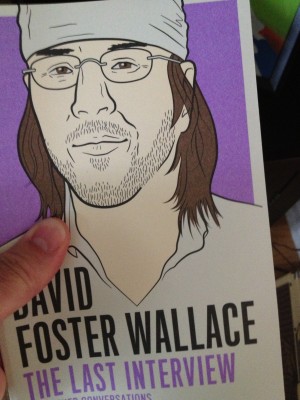
DFW: The Last Interview, Reviewed

David Foster Wallace, The Last Interview

There’s a new issue of the Quarterly Conversation out. Not only does it have my review of David Foster Wallace: The Last Interview, it also contains Andrew Altschul on Wallace’s posthumous collection of nonfiction Both Flesh and Not, David Winters on Sam Lipsyte’s new story collection, and Dev Varma on Azareen van der Vliet Oloomi’s novel Fra Keeler. I included that last one because Varma is a friend and I enjoyed getting to type all of those letters. Enjoy!

Notes on ‘We Looked Like Giants’

Well I’ve started to blog for Full Stop, and my first post is about Craig Mod’s idea of “subcompact publishing” and how it might relate to the future of literary magazines. I realize that it’s a bit strange that I’ve started blogging elsewhere, since I seem to be constitutionally incapable of updating this blog with any semblance of regularity. But we’ll see how it goes.

Here are some notes and tangents that didn’t make it into the little piece but that for some reason seem worth preserving, despite their fragmented nature. Or perhaps this is just the age-old desire to have every thought appear in some type of print. (Also, it could reveal the true reason these scraps weren’t included in the first place.)
#
In the wake of The Magazine beginning, and Rupert Murdoch’s The Daily folding, and Mod’s essay appearing, and The Awl’s own Weekend Companion app appearing, there’s been a great deal of chatter in the system about all of this. Felix Salmon thinks that tablet-only publications won’t work ultimately, though admittedly he’s focusing more stringently on daily journalism.
#
Related question: what exactly is journalism now? If we define journalism simply by its frequency of delivery–that is, a periodical publication, a publication that continually publishes installments–rather than its actual content, then aren’t we all journalists now? In that light the crisis of newspapers is simply the crisis of certain information delivered in this particular way, but periodical publication itself is quite healthy (at least in terms of as an endeavor of human attention).

For a better, more cogent version of this paragraph, read this piece from the Awl published yesterday.
#
What is the point of subscribing to a publication? I mean for the individual reader, not the advertising-hungry eyes of the publisher. Is it simply the relief of not having to pursue each issue. (Why is it again that I can’t subscribe to groceries?)
#
I do realize that I did not talk about Byliner, The Atavist, Longform, etc., and that I generalized (am generalizing) kind of recklessly about literary magazines as a generic whole, which is probably not smart given that the variety is so great that even the term “literary magazine” isn’t completely useful.
#
Related: what exactly is a literary magazine? What does that phrase mean? A magazine of literature? But then, what exactly is literature? Or is it a magazine of items that aspires to be literature?
#
Is there an aesthetic or structural reason that the long-form in-between size e-publications have focused almost exclusively on nonfiction? (Is there some wealth of e-pub novellas that I’m missing?) Or is just because no one reads fiction, at least in a large enough way to motivate this kind of experimental publishing work?
#
I didn’t mention The Periodical Co in my post and I should have. This application/service (what do I call all this stuff?) was created while I was writing the piece and it provides a way for civilians to create their own subscribable newsstand app.
#
Hold on. I have to go back to Craig Mod’s website for a few minutes.
#
A corollary to this is the online versions of the New Yorker. For personal organizational reasons I won’t go into here (i.e., hoarding), I subscribe to the New Yorker via the Kindle. Doing this, I lose so much of the magazine: the wonderful feel of the glossy paper, the spot illustrations, all those perfume ads, that typeface, that general concrete weekly manifestation of the New Yorker as some asteroid of civilization careening into my life. But all that aside, it still shows up without me having to lift a fat finger, and after getting over what I’ve lost, it’s awfully convenient to read it on the Kindle, which because of its sea green e-ink get up (I’ve got the slate grey Kindle that has the keyboard at the bottom; I could look up which specific model it is but what is this? some kind of tech blog?) renders the New Yorker fairly “subcompact” in this version. And I’ve resisted the temptation to download the iPad app version because of the horror stories I’ve heard of download time and complications.
#
My one goal in life is to minimize the time I spend do anything that could be remotely construed as “syncing.”
#
I’ve always wanted to write in pretentious epigrams!
#
All this is to say that I’m predisposed to think whatever Mod says is right and true but he does have a point. He made me overcome my tendency to procrastinate and finally download The Magazine. And it’s usability is great: sharp and crisp and quickly there on my phone and just easy to use. I was thumbing away happily in no time. The writing itself is somewhere in the middle. It’s not yet quite good enough. My favorite article thus far is “The Sound of Silence,” Glenn Fleishman’s longer piece on the Library of Congress’s sound archive in the wilds of Virginia. It’s full of information and neat detail. The rest of the articles are a little too bloggy so far. (I realize the irony of this criticism.) What I mean is that the essaylets are essentially personally informe-but-fleeting-feeling opinions about observable trends in the tech-net-blogo-plex. Not that these are unworthwhile, but I felt an interior grain of conventional desire for something with a little more fiber, since it was a, you know, magazine. But anyway, I’m enjoying it.
#
Man, that is just one lovely smooth interplanetary excellence gold medal of a website.
#
Sometimes, in my more vein-popping moments, I think that fiction and the like should simply stay off line as a matter of principle, a concrete illustration of how they are different. That is, you buy print copies of stuff you actually intend to read and you skim what’s freely available online.

But then I think that idea is just wilfully dumb.
#
The history of tech has shown that people will forgo fidelity/excellence/fanatical attention to detail for cheap and fast, that is, for efficiency. And then, after everything is efficiently available, the fanatically excellent becomes a recidivist status symbol.

Am I using “recidivist” correctly?
On the radio

Warning: this blog post has actual content, rather than just mooning about Philip Roth. Though, to be fair, there should be a fair amount of that, too, since Roth has announced his retirement from writing. This news is so big that I can’t even quite blog my head around it, so in lieu of a loose sally of the mind, I give you self-promotion.

I did an interview last week with WJTK’s North Florida Today (96.5). I’m talking about the book with host Ken Allen. This was my first radio interview ever, and if you listen closely, you can hear me sweating through my clothes.

I am also scheduled to do a live interview on “Mornings with Al” on WYRQ-FM broadcast out of MINNEAPOLIS/ST. PAUL, MN. That will air at approximately 7:10 am CT this Tuesday, December 18. I’ll post a link when I can.

A note from the official interlocutor

Well Philip Roth is in the news again, which must mean it’s time for me to blog once again. This time, Roth has written an “open letter” to Wikipedia to correct a collectively generated mistaken presupposition about the origin of his 2000 novel The Human Stain.

The letter is fascinating and amusing for lots of reasons. (O to have one’s open letters published online in the New Yorker!) On the one hand, Roth gets to correct the record, which he seems intent on doing here in his later years. My last blog post and the last occasion for a newsy flare-up related to the novelist was Roth writing in to The Atlantic magazine to clarify whether or not he in fact had a “crack up” way back when, as the magazine had alleged. Both of these clarifications hit the he-doth-protest-too-much sweet spot, and this last Wikipedia correction in particular strikes one as an older generation being caught in the barbed snares of the younger generation, the mustard gas of Web 2.0 wafting overhead.

But at the same time the letter also provides Roth a “second source,” the item he needs to correct the record on Wikipedia. Here is Roth:

Yet when, through an official interlocutor, I recently petitioned Wikipedia to delete this misstatement, along with two others, my interlocutor was told by the “English Wikipedia Administrator”—in a letter dated August 25th and addressed to my interlocutor—that I, Roth, was not a credible source: “I understand your point that the author is the greatest authority on their own work,” writes the Wikipedia Administrator—“but we require secondary sources.”

He gets to point out the ridiculousness of the Wikipedian policy while also submitting to it.

This is of course ludicrous—the man’s Philip Roth!—and simultaneously right and correct. Because even though Roth protests that Coleman Silk, the protagonist of The Human Stain, was not modeled on the late literary critic Anatole Broyard, as the Wikipedia comment claimed, we as readers are free to make that interpretive mistake. It’s not like that charge came out of nowhere. That intrepretation—that the black literary intellectual who was “passing” as a Jewish intellectual, which is essentially what Broyard did—has been in critical circulation ever since the novel came out. And as biographically interpretive theories go, it ain’t that bad (or, all things considered, that violent of a conjecture to the author’s reputation or the novel’s aesthetic import). In short, if we, as readers, want Silk to be modeled on Broyard, then he is modeled on Broyard.

But at the same time it’s awfully fascinating to hear Roth go on in a Henry James-ian rumination about the germ of the original novel and to pontificate briefly about the need to make stuff up. In all of the semi-recent internet chatter about fiction vs nonficton vs nonfiction that may perhaps contain some not-quite-verifiably-truthful elements, it’s heartening to see someone so fully committed to making stuff up—where grafting imagined activities onto the root of reality is both a freedom and a burden.

And at the same time the whole thing reads like a scrap from one of Roth’s own novels—the novelist claiming that he is who he says he is despite the Kafkan internet behemoth claiming that’s not good enough, a desperate impotent rhetorical flight of self-validation! Of all the things that Roth’s ouvre has contained, surely that’s a main ingredient of it.

Notes on Notes

I was on Twitter today and I wondered if people tweet about not tweeting, the way that people used to blog about not blogging. And I have been myself thinking of drafting a blog post about my inability to regularly post a blog post, but then I thought christalmightywhocares. There’s nothing to blog about anyway.

But then, I thought of something to blog about, so here we go. I saw on the Atlantic magazine’s website today that Philip Roth had written them a letter disputing Joseph O’Neill’s claim that he had a “crack-up” in the mid-80s. The factual correction is interesting in and of itself. One could imagine the source of confusion, since Roth’s novel Operation Shylock, narrated by a fictional Philip Roth, talks about a breakdown resulting from taking the same true, factual medication Roth mentions in his letter. (Halcion.) On the one hand, you kind of nod your head primly at the fact-checking wrist-slap, but then think, Well isn’t this factual/fictional biographical confusion partly the point?

But more important than that, one reels at the idea that Roth is up there in New England reading Atlantic essays about himself. Did he actually read it? Was he tipped off? Or is it actually not that hard to imagine him reading the Atlantic? I imagine him writing, walking in the woods, lifting weights with dumbbells made of volumes of the OED, and, for some reason, doing a lot of bikram yoga.

I haven’t read the O’Neill essay, mainly because I’ve grown so crotchety and proprietary in my complicated affection for Roth’s books that I’m wary of reading additional criticism. (How’s that for being intellectually stubborn?) However, cynical defense mechanisms aside, I can recommend without reservation David Gooblar’s recent book The Major Phases of Philip Roth. I interviewed Gooblar about the book for the Quarterly Conversation. His book gives you the best kind of scholarly double-pleasure: it shines new light on Roth’s work while sending you speedily back to the books themselves. It’s scholarship as harmony, a dedicated major third humming above the source text.

One last note about that Atlantic piece: it’s illustrated with what must be one of the only pictures of the older Roth with visible beard stubble. He looks — with his stare, his slightly mussed hair, his stubble — old. I realize that he in fact is old, but it seems like the Atlantic is trying to highlight this with the photo. That is, it seems like they’re trying to make him look bad. Perhaps I’m just projecting but this seems to me in poor taste.

But what’s really in poor taste is how they handle the article’s URL. Here’s how they title the article: “Philip Roth Clears Up His ‘Crack-Up.'” But here’s the web address of the article:

http://www.theatlanticwire.com/national/2012/05/philip-roth-clears-his-crack-/52754/.

Thank you, Atlantic Monthly, for keeping it classy. You must be so proud of yourself.

And with that, I return to my glacial pace of irregular blogging.

Heading home to Jackson

Thank you to everyone who came out to the book signing/reading at Burke’s two Thursdays ago. It was a stuffed house, and I left feeling equally stuffed with gratitude. There’s a nice little essay by Nicholson Baker about reading one’s work aloud and the always present prospect of becoming choked up at completely inappropriate moments. It’s not so much a case of being emotionally moved by one’s own work as it is the spontaneous flood of tears at a moment of high stress. However, I am happy to say that I proudly avoided weeping while reading. That’s one of the two things I always pray for before a reading: that I will not begin to spontaneously weep and that I will not trip and fall while reading.

In other news, the Memphis Flyer ran a nice write up before the reading and they have posted an extended Q&A here.

And in additional other news, I take my one-man-signing show on the road this weekend and will proudly deface copies of my book at Lemuria in Jackson, Miss., at 1 p.m. on Saturday, Feb. 4. This is my hometown bookstore, site of countless afternoons spent mooning among the paperbacks. I am not reading at this one, just signing, which is good, because at Lemuria all I would do is weep.

p.s. I finally updated my FAQ with some pressing questions that have been coming my way. Feel free to send more.